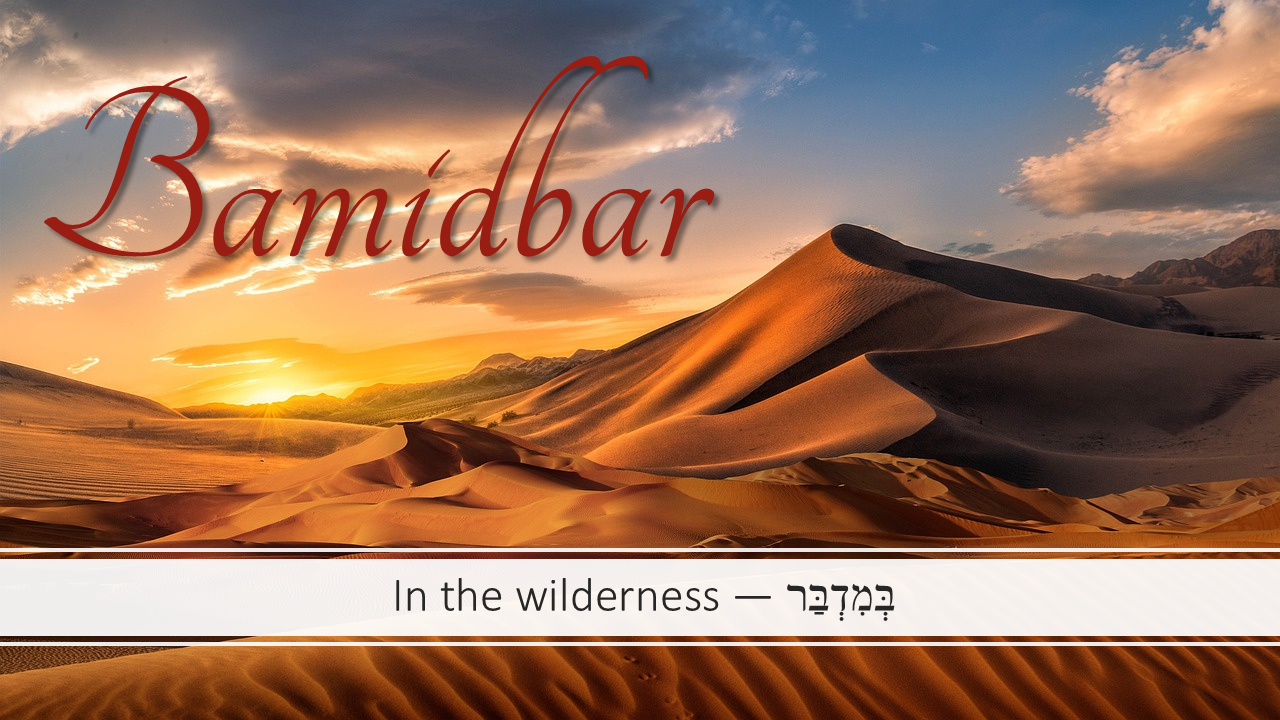
This week as we begin the book of Bamidbar (Numbers), let’s start with a recap. Shemot (Exodus) and Vayikra (Leviticus) described for us the escape of the Israelites from their captivity in Egypt, the giving of the Torah on Mount Sinai, the erection of the Tabernacle, and the definitions of holiness, clean and unclean. The first ten chapters of Bemidbar will cover 20 days during which there will be two censuses performed and special organization geared towards preparing them for their march through the wilderness. The rest of Bemidbar will take the Israelites through the wilderness to the borders of the Promised Land, albeit amidst trials, tribulations, and death of a generation.
The word Bamidbar (בְּמִדְבַּר) means “in the wilderness”. In the Scriptures, the wilderness (midbar) is not necessarily the desert area, but rather the uncharted territory we find ourselves in usually during exile. The root of wilderness (debar) means “to speak” or “words”. Thus the very literal meaning of bemidbar is “in the place of speaking” or the “place of words”.
Haftarh Portion Summary
In the day when the Mashiach returns, the Jewish People will again be called "My People" and "Sisters who have regained God's Mercy." Meanwhile, the children of Israel are urged to chastise their Mother Israel, who has reduced herself to the level of the unfaithful wife. Therefore, the LORD will punish Israel and remove her from the joy of the land.
Nonetheless, God will have mercy on Israel yet again, and turn all the harsh punishments into great blessings. The LORD will "speak tenderly" to Israel and restore her to condition when He ransomed her from bondage in Egypt:
And I will betroth thee unto me for ever; yea, I will betroth thee unto me in righteousness, and in judgment, and in lovingkindness, and in mercies. (Hos. 2:19)
In the coming millennial kingdom, when Yeshua the Mashiach reigns in Jerusalem, the Jewish people who survived the tribulation will at long last be fully restored as God's covenant people upon the earth.
B'rit Chadashah Portion Summary
In chapters 9-11 of the book of Romans, the Apostle Paul (Rav Sha'ul) discusses God's great plan for Israel (and the nations). Concerning national Israel and the calling of the Gentiles as partakers of the covenants, the Apostle quotes from Hosea (2:23 and 1:10, respectively), and applies them directly to the church of God:
	Those who were not my people (lo ammi) I will call 'my people' (ammi),
	and her who was not beloved I will call 'beloved.'
	And in the very place where it was said to them, 'You are not my people,'
	there they will be called 'sons of the living God' (b'nei el chai).
	---------------------------------------------------
	and I will say to Not My People 'You are my people';
	and he shall say, 'You are my God' (Hos. 2:23)
In other words, there has always been provision for the nations to come into relationship with YHVH through the grace of God. Although the ethnic Jews consider themselves to be am segulah, a treasured people, ever since Abraham (the very first "Jew") the LORD had intended to call out people from every tongue and tribe to be His own children.
In the end there will be "one new man," a redeemed group of peoples - both Jew and non-Jew - who will live in covenant with the LORD forever and ever. In light of the sovereign plan of God, this segment of Romans concludes with the contrast of the ways of justification as espoused by Judaism and Christianity, respectively:
What shall we say, then? That Gentiles who did not pursue righteousness have attained it, that is, a righteousness that is by faith; but that Israel who pursued a law that would lead to righteousness did not succeed in reaching that law. Why? Because they did not pursue it by faith, but as if it were based on works. They have stumbled over the stumbling stone, as it is written, "Behold, I am laying in Zion a stone of stumbling, and a rock of offense; and whoever believes in him will not be put to shame."